
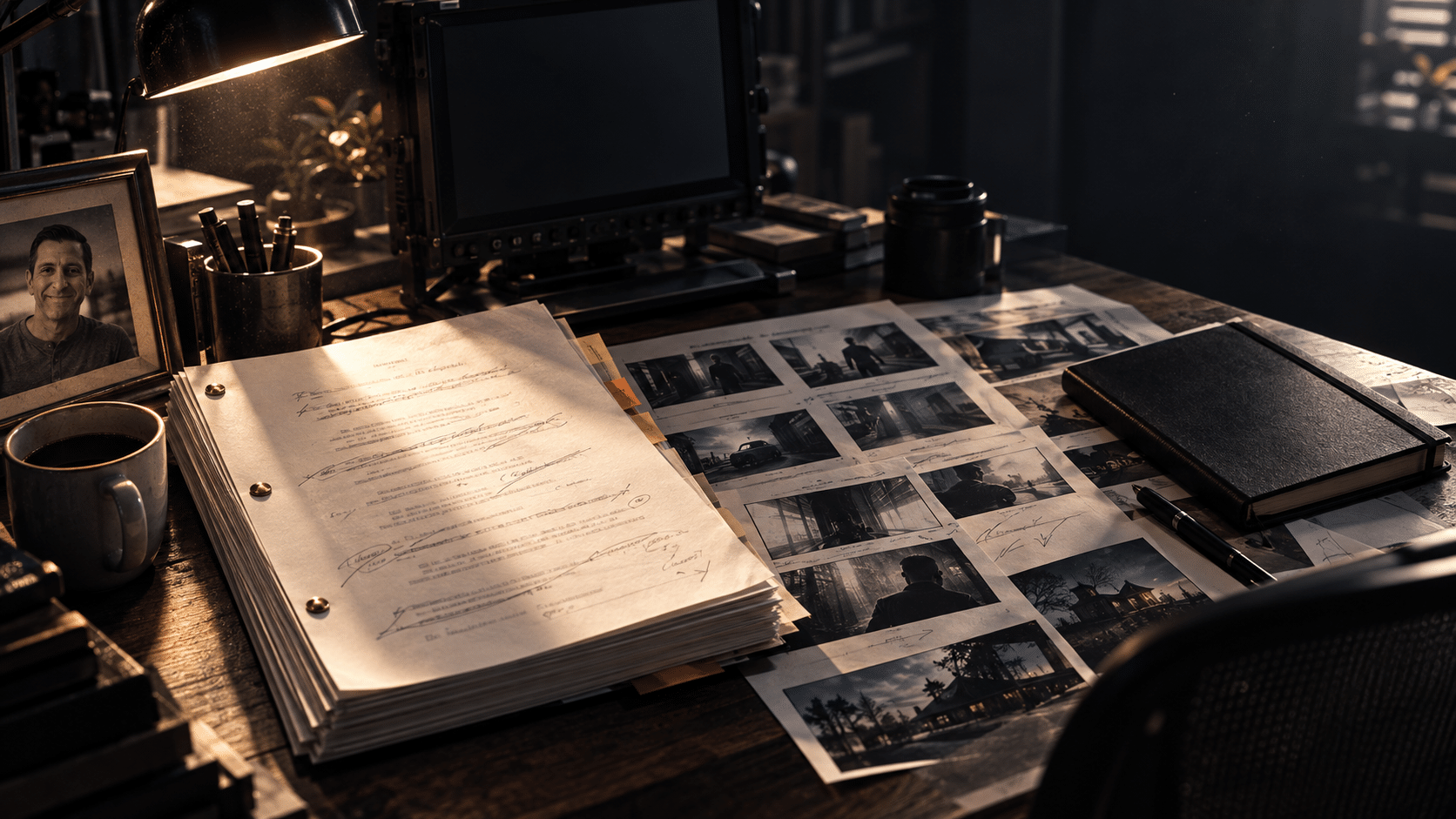
The Making of White Wolf, Part 1 of 7. Before the edits, before the festival submissions, before I had an entire movie staring back at me from a timeline, there was a simple and slightly unreasonable question: what if I actually made this?
Late May: making the people real
The first concrete work was not an action scene. On May 22, I was building reference looks for six central characters: three looks each, eighteen in all. Ordinary clothes, different sides of their lives, details that would make them recognizable from shot to shot. Even the sunglasses needed a rule. One version of Dad wore them; the other looks could not all become the same guy in a different shirt.
That sounds small until you ask an image or video model to keep one person consistent across a feature. A character is more than a face. It is the way that face reads in a room, the clothes that belong to a moment, the age and presence that still feel right after a cut. Those early references became the foundation for everything that followed.
June: the movie gets a spine
By early June, the core of White Wolf had taken shape: an ordinary New Jersey father pushed into an extraordinary fight to get his family back. I am an IT director and a dad of four. I did not want to write a secret operative who suddenly discovers he knows everything. The human starting point mattered more to me than the size of any action sequence.
The script developed into thirteen chapters and an epilogue. By June 22, it existed as an actual screenplay and production roadmap, not just a promising premise. I was breaking that larger story into short, shootable pieces while keeping a full feature in mind. I needed to know why a scene was there, what changed during it, and what the audience should feel when it ended.
The first proof
By that same June 22 checkpoint, about eight minutes were already in the can. The first trailer was also enough to convince me this could work. The footage was rough, and I had no illusions about what remained, but it changed the question from “Could I make this?” to “How do I finish it well?”
A few days later, the screenplay, character looks, visual style, and opening footage were all moving together. That is the part I remember most about the beginning. It was no longer one big dream. It was a pile of very specific decisions I had to make, one after another.
Next: how those early character references became a visual plan strong enough to carry hundreds of separate shots.
This is the first article in a seven-part making-of series. The next part publishes tomorrow.
Leave a Reply