
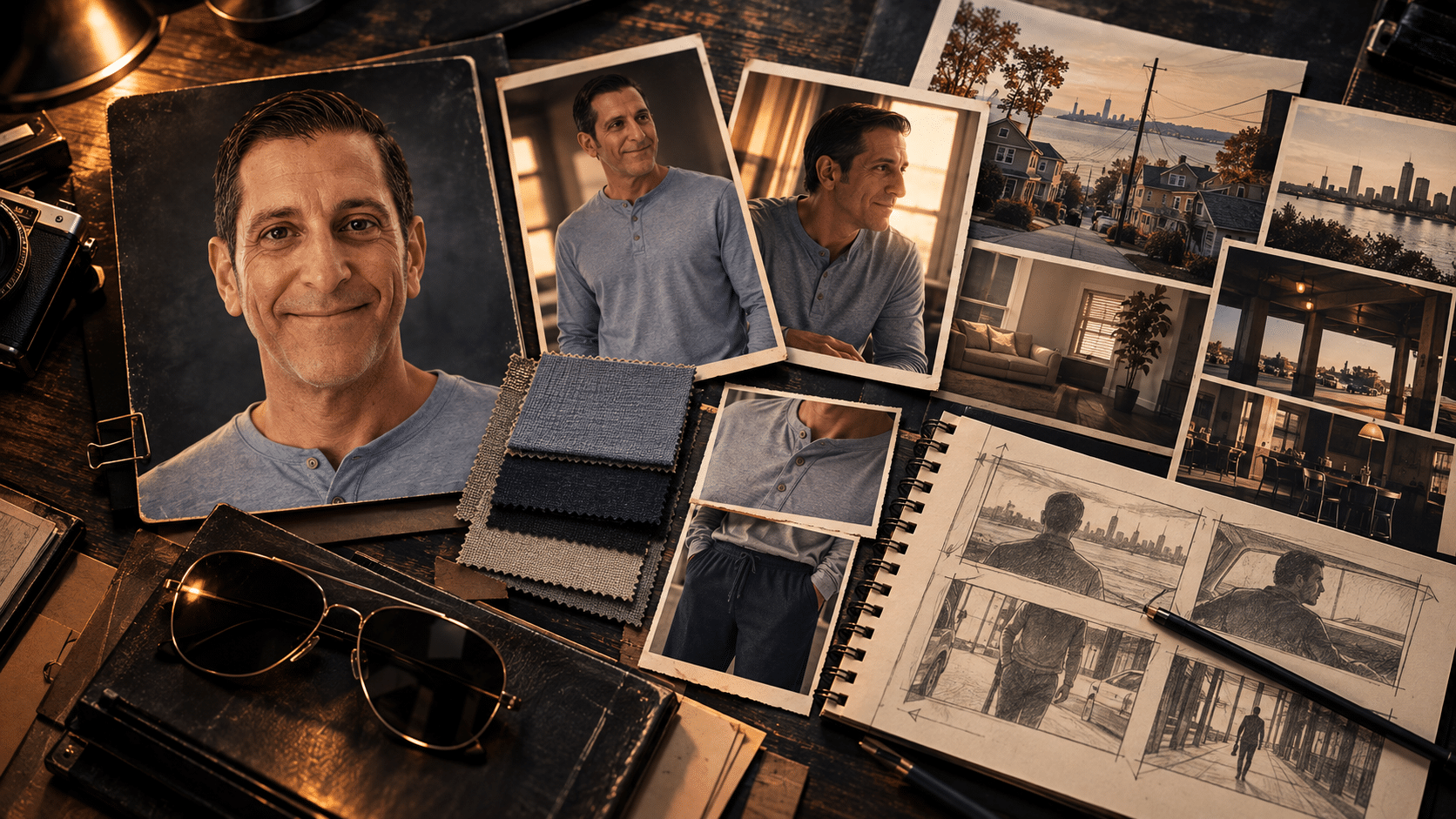
The Making of White Wolf, Part 2 of 7. A screenplay tells you what happens. It does not automatically tell a video model what your actor looked like forty shots ago, whether the light belongs to the same afternoon, or which jacket was in the last scene.
That was the problem I had to solve before the production could scale.
A movie needs memory
The character sheets started with faces and clothing, but they quickly became a way to remember the movie. I built reference material for recurring people, places, and visual beats so that every new clip had something concrete to answer to. Some references showed the ordinary, familiar world. Others established how the film could grow more severe without suddenly looking like a different project.
I approached the story in chapters, then broke each chapter into smaller shots. In June the working plan was built around short segments, often about thirty seconds on paper. A scene could ask for a wide frame, a reaction, a movement, and a transition. Once those needs were clear, I could choose what footage to generate instead of hoping a single prompt would solve the scene.
Consistency is direction
That is where directing an AI-assisted film became very practical. What is the camera doing? Which detail carries the emotion? Does this shot have to connect to the one before it, or give us a breath before the next one? If a take looked beautiful but broke the character or geography, it was not the right take.
By June 27 I had a completed screenplay, an established visual style, a teaser, a trailer, and the first several minutes of the feature. It was still early production. What I had, though, was a language I could keep returning to when a new result wandered off course.
The reason for all that planning
The goal was never to make every frame identical. A movie should have variation. The goal was to make the variation feel intentional, so a viewer could follow the people and the story without having to stop and ask why the world changed between cuts.
I still had hundreds of clips to make. The visual plan did not make that easy. It made the next decision possible.
Next: what happened when the plan met Pollo, Seedance, rerolls, and an enormous pile of footage.
Previously in this series: How White Wolf Began: A Father, a Script, and 18 Character Looks.
Leave a Reply